
Communications and marketing are different functions that collapsed into the same word. A client opens a procurement process, writes "we need an agency" and gets proposals that all look alike. Some talk about media relations, positioning and crisis. Others talk about paid media, funnels and ROAS. Both talk about "digital presence" and "brand positioning". You quote six, sign within three months, and discover in the fourth that you bought half of what you needed and twice what you did not.
This article separates the two functions at the root, shows the three practical signals that distinguish one from the other, and explains when to hire each (or a single operation covering both, which is where Koko works).
The difference in one sentence
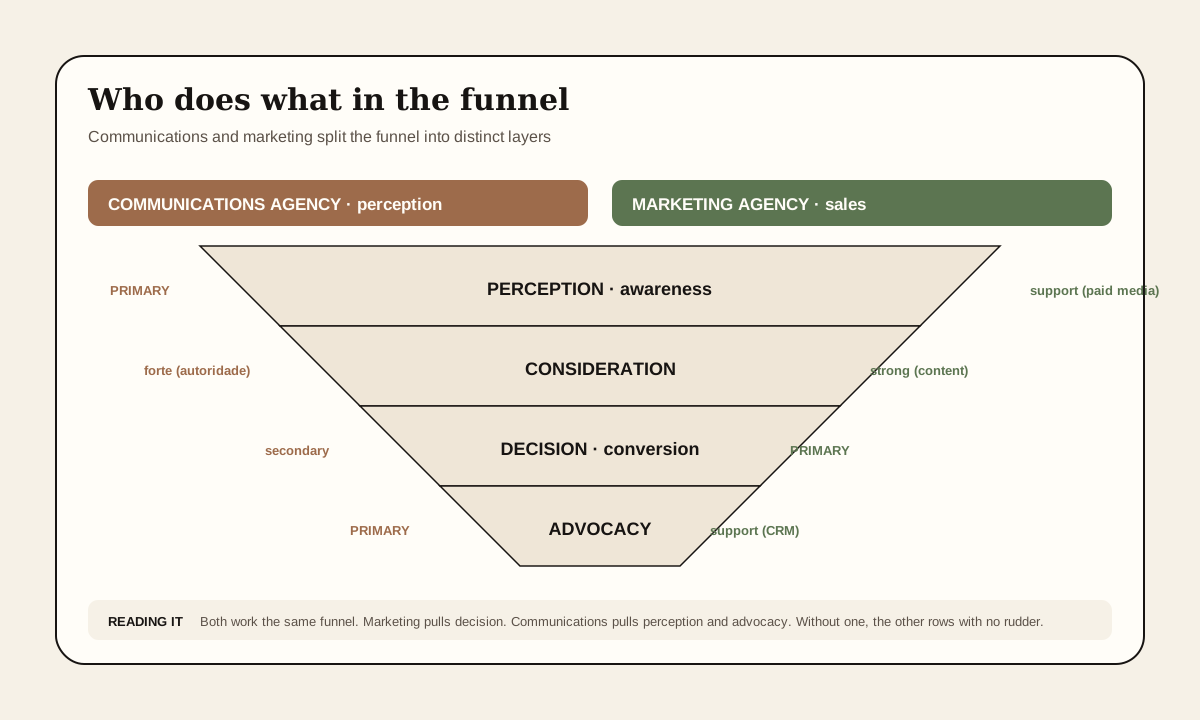
A communications agency works on how the market perceives you. A marketing agency works on how much the market buys from you. They are two halves of the same revenue problem, and they operate with completely different vocabulary, KPIs and team profiles.
That is where the knot is. Both talk about "brand", "positioning" and "presence". But what sits under those words changes radically between one operation and the other.
The 3 fundamental differences
1. Scope: what is in and what is out
| Function | Communications agency | Marketing agency |
|---|---|---|
| Media coverage | PR, media relations, managing journalist relationships | Buying paid media (Meta, Google, programmatic) |
| Content | Branded content, ghostwriting, position papers, corporate content | Funnel content, performance, SEO/SEM content, blog |
| Events | Corporate events, brand launches, summits, awards | Lead-gen webinars, conversion events |
| Crisis | Crisis management, spokesperson training, reputation monitoring | Not covered |
| Tracking | Not covered (or covered superficially) | Pixel, CAPI, GA4, multi-touch attribution, CRM |
| Website | Corporate content, positioning | Conversion, growth, funnel optimization |
| Social | Community, voice, verbal identity | Editorial calendar that sells, organic growth, ads |
A communications agency rarely knows how to configure a Meta pixel properly. A marketing agency rarely knows how to negotiate with a national newspaper's business editor. You can find an agency covering both (the last section of this article is about that), but it is the exception, not the rule.
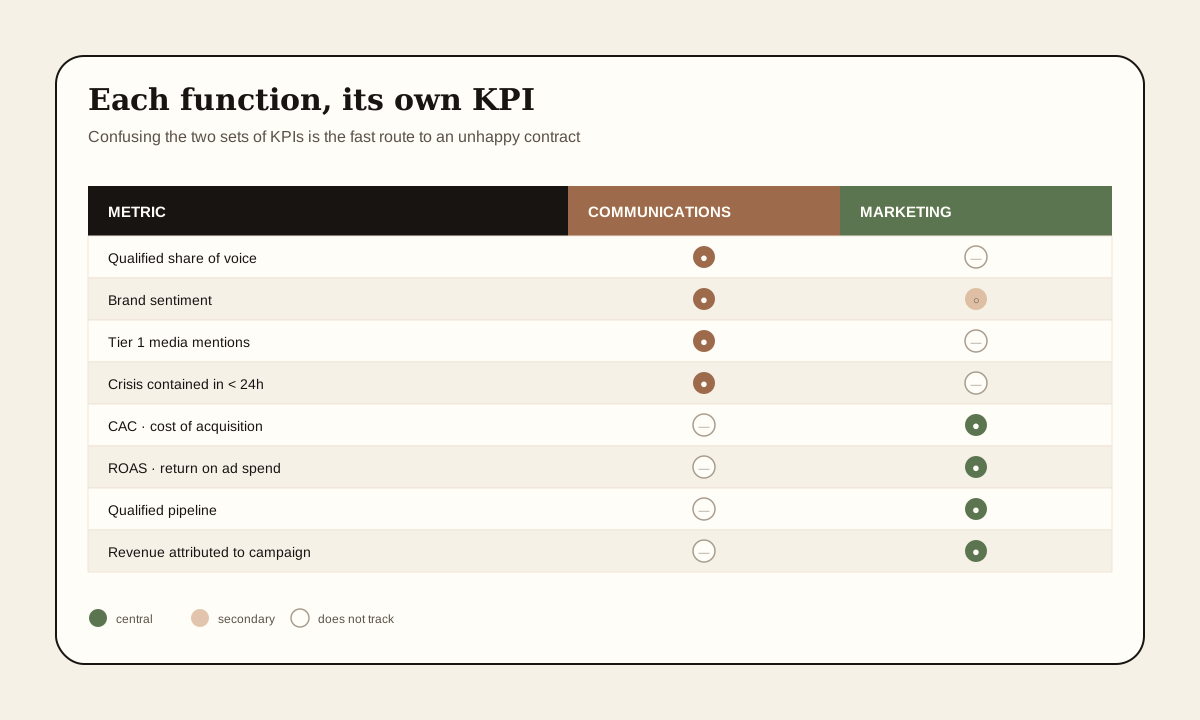
2. KPIs: how each one measures success
| Metric | Communications | Marketing |
|---|---|---|
| Share of voice | Central | Secondary |
| Brand sentiment | Central | Indirectly useful |
| Qualified tier 1 media mentions | Central | Does not track |
| Assisted awareness | Central | Intermediate metric |
| CAC (cost of acquisition) | Does not track | Central |
| ROAS | Does not track | Central |
| CTR, CPL, CPM, LTV | Does not track | Central |
| Qualified pipeline | Does not track | Central |
| Attributed revenue | Does not track | Central |
| Crisis contained in < 24h | Central | Does not track |
The reading is direct. If your pain is "nobody has heard of us", the KPI is on the left side of the table. If your pain is "we are running campaigns and they do not convert", it is on the right. Confusing the two is the fast route to hiring wrong.
3. Client profile: who usually hires each
A communications agency more often serves:
- Companies with an established brand needing to hold or reposition perception
- Regulated sectors (health, finance, energy, government)
- Operations at a sensitive moment (M&A, IPO, C-level change, public crisis)
- Brands with high reputational risk (sector leaders, multinationals, public exposure)
- Individuals with an authority profile (CEO, board member, author)
A marketing agency more often serves:
- Companies in aggressive acquisition mode (sales scaling, geographic expansion)
- E-commerce, info products, SaaS, B2B with a mapped pipeline
- Operations with a defined funnel and clear pain at some stage (attract, activate, convert, retain)
- New brands needing to accelerate recognition through paid media
- Businesses where every $1 of media has to become $X of revenue on a short horizon
Not an absolute rule. But the pattern is clear enough to locate yourself. If today's pain fits the first list, communications. If it fits the second, marketing.
When you need communications
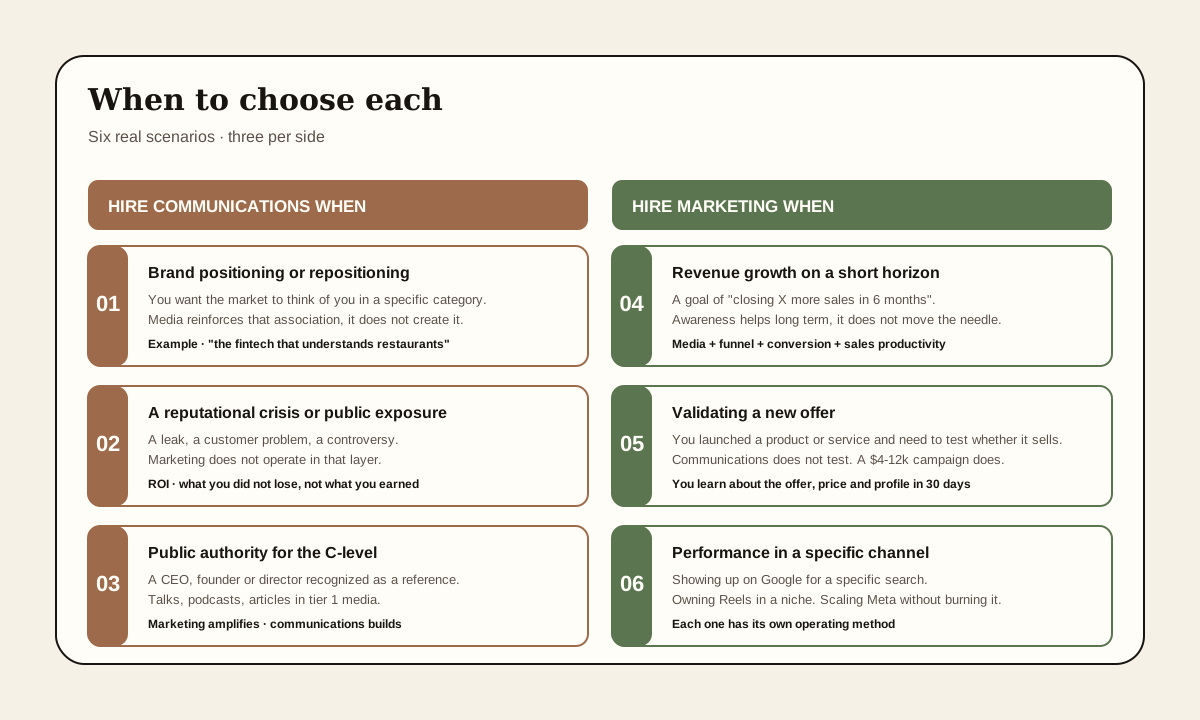
Three typical scenarios where pure marketing does not solve it.
Brand positioning or repositioning. You want the market to think of you in a specific category (the "B2B paid media agency in Vancouver", the "premium builder in New Westminster", the "fintech that understands restaurants"). Paid media reinforces but does not create that association. It needs PR, corporate content, a consistent authored voice.
Crisis. There was a leak, a customer problem, a controversy. Marketing does not operate in that layer. Communications does, and its ROI is how much you did not lose, not how much you earned.
C-level authority. You want the founder, CEO or a director recognized as a reference. That is public image building: talks, podcasts, articles in tier 1 media. Marketing can amplify it, communications builds it.
When you need marketing
Three typical scenarios where communications does not solve it.
Revenue growth on a short horizon. The goal is "close 20 more sales a month over the next 6 months". Awareness helps long term, but what moves the needle is media, funnel, conversion optimization and sales productivity.
Validating an offer. You launched a new product or service and need to test whether it sells. Corporate communications tests nothing. Marketing tests in 30 days with a $4,000 to $12,000 campaign, and hands you brutal learning about value proposition, price and customer profile.
Performance in a specific channel. You want to show up on Google for a specific search, own Reels in a niche, scale Meta Ads without burning the account. Each of those has its own operating method, and it lives in marketing, not communications.
When one agency covers both (and when it does not)
Most of the market operates in silos. You hire media relations on one side, a paid media agency on the other, and you become responsible for stitching the narrative between them. When it works, it works well. When it does not, and that happens often, you discover the PR agency pitched a story with positioning the media agency had already invalidated in an A/B test.
The single-operation model only makes sense when the agency genuinely covers both ends. Large agency brands historically had that, with separate PR and media departments under the same leadership. Recent boutique agencies, like Koko, build the model differently: senior specialists in both areas, but talking on a short cycle, with the same funnel strategy running in parallel on both sides.
Signs the unified model works for your operation
- You have fewer than 200 employees and do not need a dedicated PR legal department
- Your brand is not in a heavily regulated sector (health under regulatory oversight, finance, government)
- You want a single narrative across organic content, paid media and PR
- You want to avoid the double coordination cost between separate agencies
Signs it is worth separating
- Crisis is part of the daily routine (sector leaders, high public exposure)
- A regulated sector with specific communications requirements (pharma, energy, financial)
- A multinational operation needing a PR agency present in multiple markets
- Budget high enough to absorb the double cost without compromising execution
For SMB and mid-market businesses in 2026, the unified model is cheaper, faster and produces a more coherent narrative. For a large, regulated operation or one with high reputational risk, separating remains the conservative choice.
How Koko runs both layers
We run communications and marketing as connected layers, with a single funnel diagnosis. Whoever runs paid media talks daily with whoever runs organic content, who talks with whoever runs media relations. There are not 3 agencies, there is 1 squad with 3 specializations under the same direction.
To assess whether the unified model fits your scenario, worth talking to us, or reading how to choose a marketing agency without wasting budget before you start quoting.
FAQ
What is the difference between a communications agency and a marketing agency? A communications agency works on how the market perceives you (PR, positioning, crisis, authority) and measures in share of voice, sentiment and qualified mentions. A marketing agency works on how much the market buys from you (performance, leads, conversion) and measures in CAC, ROAS and qualified pipeline.
Can I hire just one of them? You can, and it is the most common thing. SMBs in growth mode usually start with marketing. Established companies at a sensitive moment or in a regulated sector start with communications. Mature operations tend to have both functions running in parallel.
Is it cheaper to hire one agency doing both? Generally yes. A unified model avoids the coordination cost between separate agencies, produces a more coherent narrative, and has a total fee 15 to 30% lower than quoting two isolated operations. The condition is that the agency genuinely has the capability, with seniors in both functions, not one dressed up as the other.
Does communications include social media? It includes the voice layer, verbal identity and community management. It does not include the growth layer, an editorial calendar that sells, or paid social. At some agencies that boundary is blurred, because social media is the one function where the two cross directly.
When do I need media relations? When you want to appear in tier 1 media, in relevant podcasts and talks in your sector, or when you need to manage a specific crisis. Paying for advertising in a publication does not buy editorial coverage. Media relations does.
What is the main KPI for each? Communications: qualified share of voice, positive sentiment, the number and quality of tier 1 media mentions. Marketing: CAC, ROAS, pipeline generated, attributed revenue. Holding one accountable for the other's metric is unfair and leads to an inevitable exit.
Does digital marketing replace communications? No. It replaces specific parts (some forms of awareness pay for media instead of asking for coverage). But reputation management, public authority and corporate PR remain communications, and marketing does not cover them.
Conclusion
Communications and marketing are two different functions that collapsed into the same word, and the confusion turns into a badly written contract. In practice they are two connected layers: perception (communications) and sales (marketing). Whoever only does one dies on the other.
For SMB and mid-market businesses in 2026, the unified agency model, with seniors in both areas operating under the same funnel strategy, is usually cheaper, faster and more coherent than separating. For a large, regulated company or one with high reputational risk, separating remains the conservative choice.
The right question at hiring time is not "which agency does more things". It is "which agency can run perception and sales together, without one sabotaging the other".
Read next
- How much a marketing agency costs in Metro Vancouver · real fee ranges, split by company size
- How to choose a marketing agency without wasting budget · criteria that hold for marketing and for communications
- Social listening: the 5 tools and the process · the layer that sits between the two functions
Sources and references
- IAB Canada · Internet Advertising Revenue Reports
- Think with Google · consumer behaviour research
- Hootsuite · Social Media Trends
This is Koko's point of view on how to treat communications and marketing in 2026: two layers, not two industries. If you want a diagnosis before you start quoting, talk to us.